Chinese Law and Society Talk Series
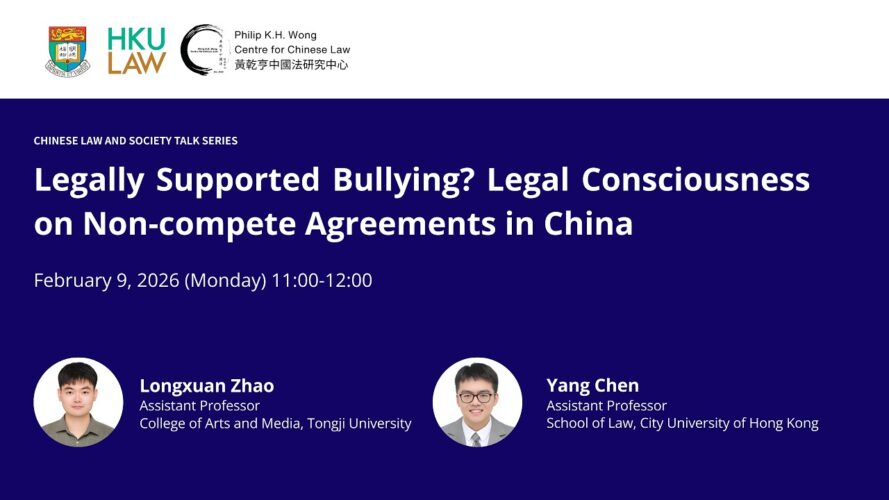
Legally Supported Bullying? Legal Consciousness on Non-compete Agreements in China
Abstract:
There are growing scandals involving Chinese companies abusing non-compete agreements (non-competes). Using legal consciousness as the research framework, this article empirically explores employees’ perceptions, interactions, and experiences with non-competes. Drawing on twenty semi-structured interviews and 344 supplementary screenshots of online discussions, this study identifies complex and intertwined forms of legal consciousness across three moments: signing, considering job hopping, and confronting activated non-competes. Employees may exhibit a “before the law” consciousness by endorsing the theoretical reasonableness of non-competes but simultaneously express a strong “under the law” consciousness in response to their overreach. Legally literate employees mobilize a “with the law” consciousness to seek remedies, while senior employees leverage resources in an “against the law” consciousness to evade enforcement. More commonly, employees develop voluntary or involuntary legal alienation, refraining from resorting to law, which enriches the framework of legal consciousness. The distorted “law in action” highlights the urgent needs for legal reforms.
Speakers:
Longxuan Zhao is Assistant Professor in the College of Arts and Media at Tongji University. His research covers the areas of Digital Sociology, Sexuality Studies, Media Culture, and Qualitative Research Methods. His work can be found from such journals as Big Data & Society, Social Media + Society, and Chinese Journal of Communication.
Yang Chen is Assistant Professor at the School of Law, City University of Hong Kong, where he teaches various intellectual property courses. His research interests primarily lie in trade secrets, the right of publicity, trademarks, and general IP theories. His works have appeared in several law journals, including the Columbia Journal of Law and the Arts, Stanford Technology Law Review, and University of Pennsylvania Journal of Business Law.
Philip K.H. Wong Centre for Chinese Law (香港大學法律學院黃乾亨中國法研究中心) at The University of Hong Kong promotes legal scholarship with the aim to develop a deeper understanding of China and facilitate dialogue between East and West. For more information, visit: https://www.ccl.law.hku.hk/