Introduction:
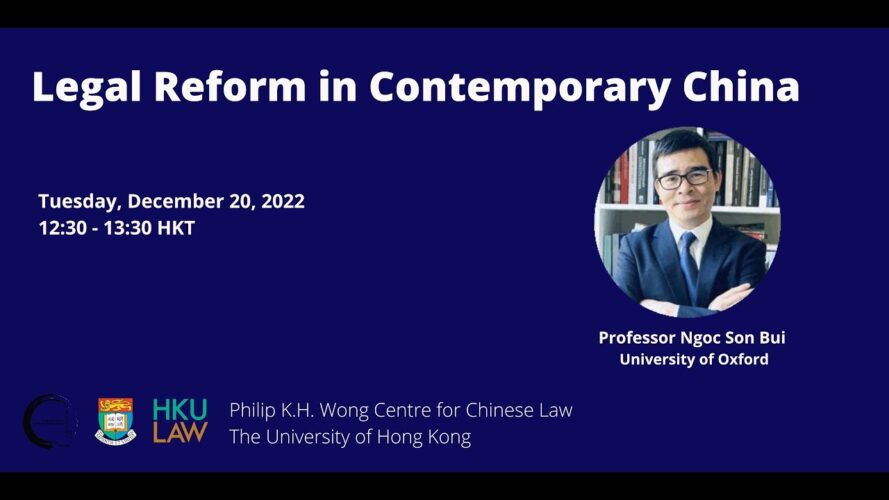
How and why has China undertaken legal reform in the last four decades? This talk introduces a positivist theory of legal reform to answer this question. Chinese legal reform has been a deliberate undertaking of political leaders to improve the socialist legal order. It is a designed change, and entails systematic, comprehensive methods of legislation. While there have been legal innovations and renovations, the core features of the socialist legal tradition remain intact. The direction of Chinese legal reform is positive; its strategy is incrementalist; it serves to bridge the gaps between existing law and socialist commitments, between law and social-economic transition, and between Chinese law and transnational legal norms.
Speaker:
Ngoc Son Bui is Professor of Asian Laws at the Faculty of Law, University of Oxford, and a Fellow of St Hugh’s College, Oxford. He is a graduate of Vietnam National University-Hanoi (LLB; LLM) and The University of Hong Kong (PhD). He was previously an Assistant Professor at The Chinese University of Hong Kong Faculty of Law, and a research fellow at the Centre for Asian Legal Studies of the National University of Singapore Faculty of Law. He is the author of Constitutional Change in the Contemporary Socialist World (OUP 2020) and Confucian Constitutionalism in East Asia (Routledge 2016).
Chair:
Professor Albert Hung-yee Chen, Cheng Chan Lan Yue Professor and Chair of Constitutional Law, University of Hong Kong
Philip K.H. Wong Centre for Chinese Law (香港大學法律學院黃乾亨中國法研究中心) at The University of Hong Kong promotes legal scholarship with the aim to develop a deeper understanding of China and facilitate dialogue between East and West. For more information, visit: https://www.ccl.law.hku.hk/