Introduction:
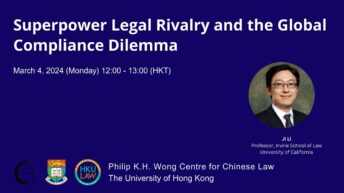
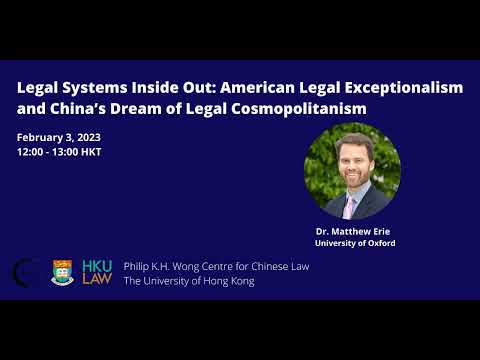
This talk explores the relationship between a legal systems’ foreign-facing elements and its domestic ones. Contrary to “dualistic” theories which suggest that a single legal system may encompass qualitatively different regimes regarding foreign and domestic legal questions, Erie takes the view that gaps between the foreign-facing and domestic aspects of a legal system may threaten that system’s legitimacy and, in turn, its sustainability. Compatibility between the foreign/external and domestic/internal aspects of a legal system could be measured across a range of categories including provision of justice, fairness, and efficiency. Erie focuses on the recognition of difference, which means both the nature and source of law and of legal authorities. The question posed is whether a legal system can regard difference disparately between its foreign-facing and domestic aspects. Erie addresses this question through a comparison between the PRC and the US, the two most powerful economies in the world and which are locked in a trade-cum-tech war.
Speaker:
Dr. Matthew Erie
Dr. Erie is an Associate Professor, Member of the Law Faculty, and Associate Research Fellow of the Socio-Legal Studies Centre at the University of Oxford. His research synergizes two types of intersections: the first is between Anglo-American common law and Asian law and the second is between law and the social sciences. Trained as a lawyer and anthropologist, his work addresses such issues as law and capitalism, alternative global orders, comparative international law, socio-legal methods and theories, and China.
Discussant:
Dr. Jedidiah Kroncke
Dr. Kroncke is an Associate Professor of law at the University of Hong Kong, joining the faculty in August of 2018. He currently teaches property, equity and trusts, as well as courses in common law reasoning for civil law students.
Philip K.H. Wong Centre for Chinese Law (香港大學法律學院黃乾亨中國法研究中心) at The University of Hong Kong promotes legal scholarship with the aim to develop a deeper understanding of China and facilitate dialogue between East and West. For more information, visit: https://www.ccl.law.hku.hk/