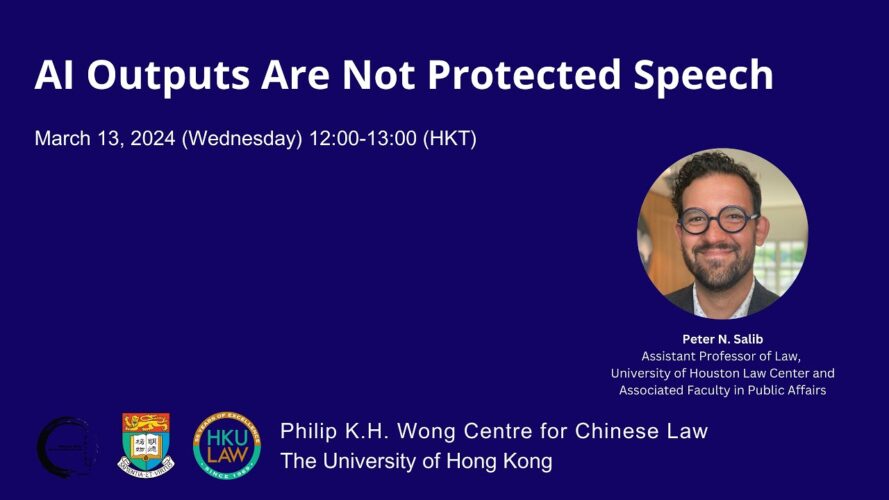
International Speaker Series Spring 2024 – AI Outputs Are Not Protected Speech
Date & Time: March 13, 2024 (Wednesday) 12:00-13:00
AI outputs are not protected speech. When a generative AI system—like ChatGPT—outputs some text, image, or sound, no one thereby communicates. Systems like ChatGPT are designed to be able to “say” essentially anything, producing innumerable ideas and opinions that neither creators nor users have conceived or endorsed. Thus, when a human asks an AI a question, the AI’s answer is no more the asker’s speech than a human’s answer would be. Nor do AI outputs communicate their creators’ thoughts, any more than a child’s speech is her parents’ expression. In such circumstances, First Amendment law is clear. Absent a communication from a protected speaker, there is no protected speech. Peter explains why as a matter of First Amendment law, free speech theory, and computer-scientific fact, AI outputs are best understood as fitting into one or more of these less-protected First Amendment categories. These insights will be indispensable to the regulatory project of making AI safe for humanity.
Speaker:
Peter N. Salib is Assistant Professor of Law at the University of Houston Law Center and Associated Faculty in Public Affairs. He also serves as Law and Policy Advisor to the Center for AI Safety, located in San Francisco. Peter is an expert in the law of artificial intelligence. His research applies substantive constitutional doctrine, along with economic analysis, to questions of AI governance. He has previously written about how machine learning techniques can be used to solve intractable-seeming problems in constitutional policy. Peter’s current research focuses on how law can help prevent catastrophic risks from increasingly capable AI.
Philip K.H. Wong Centre for Chinese Law (香港大學法律學院黃乾亨中國法研究中心) at The University of Hong Kong promotes legal scholarship with the aim to develop a deeper understanding of China and facilitate dialogue between East and West. For more information, visit: https://www.ccl.law.hku.hk/